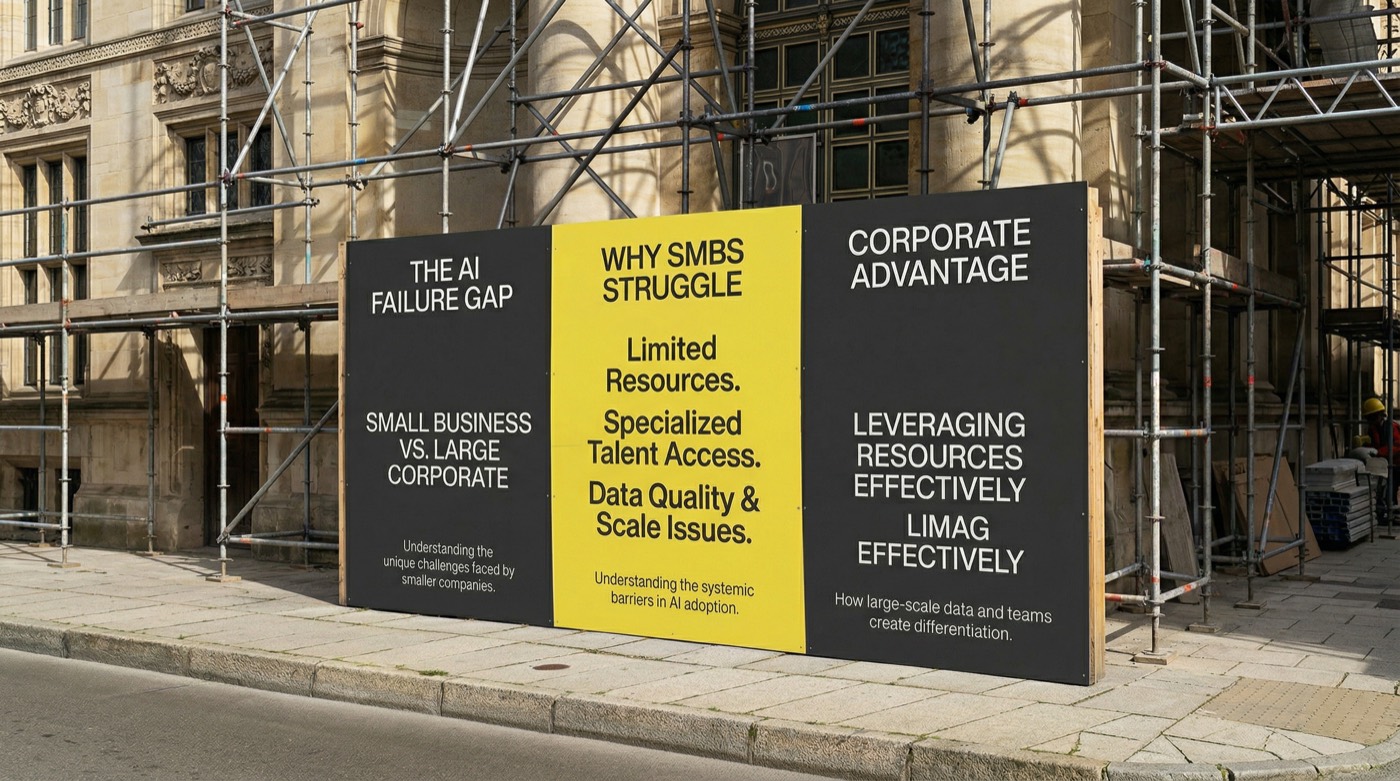

The numbers behind the problem
The Netherlands has impressive AI adoption figures. But behind that adoption lies an implementation problem. Research by CBS/RVO on AI in SMEs shows that lack of knowledge is the biggest barrier. And research by Gartner and McKinsey consistently shows that 50 to 75% of all AI projects fail to meet their original objectives.
Mistake 1: Starting too big
The most common pattern: an ambitious first project. "We want a fully AI-powered customer service." Or: "We're going to automate all marketing content with AI." This sounds logical. If you're starting anyway, start big. But it's a trap.
Large projects have many dependencies, require alignment between multiple teams, and only deliver results after months. When the first outcomes disappoint or are delayed, buy-in evaporates. The project gets shelved, and the conclusion is: "AI doesn't work for us."
The solution: start with one process, one data point, one team. Deliver a first result within two weeks. Build from there.
Mistake 2: Technology before strategy
The order matters. In many SMEs, the conversation starts with a tool: "We're going to use ChatGPT" or "We're going to automate with Make." But without a clear problem behind that choice, the tool solves nothing.
The right order: define the problem and the desired outcome first. What consistently costs time right now? Where are avoidable mistakes being made? What would it deliver if this improved? Only then do you pick a tool that fits.
Mistake 3: Not assigning an owner
AI projects that belong to "everyone" in practice belong to no one. There's enthusiasm at the start, but when decisions need to be made, when things get difficult, when prioritisation is needed, it's unclear who has decision-making authority.
The solution is simple but often skipped: assign one person who is responsible for the outcome. Not for the technology, not for the implementation, but for the result. That person reports, escalates, and adjusts course.
Mistake 4: No centralised approach
AI in SMEs is often deployed per department, per employee, ad hoc. Marketing uses Claude for copy, sales uses ChatGPT for outreach, management uses a different tool for strategic analysis. No coordination. The result: duplicate work, conflicting outcomes, and no knowledge building within the organisation. What works isn't shared. What doesn't work gets tried again.
Research from the MKB Servicedesk 2025 study shows that businesses with a centralised AI approach report significantly better results than those where AI is deployed ad hoc.
What does work?
The businesses that successfully implement AI have three things in common.
- Start small: one task, one week, one measurement. Only when that works do you expand
- Problem-first thinking: the problem leads, not the tool. "What consistently costs time or money right now?" is the right opening question
- Iterate: implement, measure the result, improve based on what you learn. No grand plan that gets evaluated after six months
"Starting small is not a sign of lacking ambition. It's the fastest route to an AI implementation that actually works."
- 74.6% of SMEs cite lack of knowledge as the main reason for failed AI implementations. Not technical failure, but strategic failure
- Starting too big is the most common mistake. Begin with one task and one team, not an organisation-wide transformation
- Technology before strategy is a trap: define the problem and desired outcome first, then choose a tool
- Every AI project needs one owner. Someone responsible for the result, not the technology
- A centralised approach beats ad hoc: businesses with a consistent AI strategy report significantly better outcomes